SD-WAN-Engineer日本語版と英語版 & SD-WAN-Engineer認定試験トレーリング
Wiki Article
BONUS!!! Jpshiken SD-WAN-Engineerダンプの一部を無料でダウンロード:https://drive.google.com/open?id=1qULDvGgP-CLz1xNMvr5wGK9F1E4w-JLc
Jpshiken のPalo Alto NetworksのSD-WAN-Engineer問題集はシラバスに従って、それにSD-WAN-Engineer認定試験の実際に従って、あなたがもっとも短い時間で最高かつ最新の情報をもらえるように、弊社はトレーニング資料を常にアップグレードしています。弊社のSD-WAN-Engineerのトレーニング資料を買ったら、一年間の無料更新サービスを差し上げます。もっと長い時間をもらって試験を準備したいのなら、あなたがいつでもサブスクリプションの期間を伸びることができます。
Jpshikenは認定で優秀なIT資料のウエブサイトで、ここでPalo Alto Networks SD-WAN-Engineer認定試験の先輩の経験と暦年の試験の材料を見つけることができるとともに部分の最新の試験の題目と詳しい回答を無料にダウンロードこともできますよ。弊社のIT技術専門家たち は質が高い問題集と答えを提供し、お客様が合格できるように努めています。
最高SD-WAN-Engineer|最新のSD-WAN-Engineer日本語版と英語版試験|試験の準備方法Palo Alto Networks SD-WAN Engineer認定試験トレーリング
今の人材が多い社会中に多くの業界は人材不足でたとえばIT業界はかなり技術的な人材が不足で、Palo Alto NetworksのSD-WAN-Engineer認定試験はIT技術の認証試験の1つで、JpshikenはPalo Alto NetworksのSD-WAN-Engineer認証試験に関するの特別な技術を持ってサイトでございます。
Palo Alto Networks SD-WAN Engineer 認定 SD-WAN-Engineer 試験問題 (Q69-Q74):
質問 # 69
An ION 3000 device at a remote branch has suffered a critical hardware failure and must be replaced via the RMA process. The administrator has received the replacement unit.
What is the correct procedure to transfer the configuration and license from the defective unit to the replacement unit to ensure minimal downtime and retention of historical data?
- A. Backup the configuration of the old device to a USB drive and restore it to the new device using the local console.
- B. Use the "Replace Device" workflow in the Prisma SD-WAN portal, which automatically transfers the configuration (Device Shell) and re-associates the site to the new serial number.
- C. Manually configure the new device from scratch, then open a support ticket to transfer the license.
- D. Delete the old device from the portal, create a new site for the replacement device, and rebuild the policies manually.
正解:B
解説:
Comprehensive and Detailed Explanation
The RMA replacement process in Prisma SD-WAN is designed to be seamless, leveraging the decoupling of logical configuration from physical hardware.
Replace Device Workflow: The administrator should use the "Replace Device" (or RMA) function within the portal. This workflow allows you to select the "Defective" device (old serial) and the "Replacement" device (new serial).
Configuration Transfer: Once executed, the system automatically binds the existing Device Shell (which contains all interface configs, routing policies, and site associations) to the new hardware's serial number. The new device, once connected to the internet, will "call home," identify itself, and download the exact configuration of the previous unit.
License Transfer: While the configuration moves automatically, the Support License transfer typically requires a specific step in the Customer Support Portal (CSP) or happens automatically if processed as a formal RMA order. Options A and D are incorrect because they involve manual reconfiguration, which is unnecessary and error-prone. Option C is incorrect as the ION platform relies on cloud-based config management, not local USB backups for hardware swaps.
質問 # 70
In the Prisma SD-WAN portal, the Application Health dashboard assigns a color-coded "Health Score" (Green, Yellow, Red) to applications.
Which three metrics are combined to calculate this composite AppX (Application Experience) score? (Choose three.)
- A. Server Response Time (SRT)
- B. Transaction Failure Rate
- C. Network Transfer Time (NTT)
- D. Bandwidth Utilization
- E. Jitter
正解:A、B、C
解説:
Comprehensive and Detailed Explanation
The AppX (Application Experience) score is a proprietary metric used by Prisma SD-WAN to provide a holistic view of user experience, rather than just network statistics. It is calculated based on three key components:
* Transaction Failure Rate (A): The percentage of application transactions that failed (e.g., TCP resets, HTTP 500 errors). This indicates availability.
* Network Transfer Time (B): The time taken for packets to traverse the network (WAN/LAN latency).
This indicates network health.
* Server Response Time (C): The time taken by the application server to respond to a request. This indicates backend performance.
Why not D or E?
* Bandwidth Utilization (D) is a capacity metric, not a direct measure of quality. A link can be 90% full but still deliver packets quickly (good AppX), or 10% full but dropping packets (bad AppX).
* Jitter (E) is a network-layer metric primarily relevant for UDP Real-Time media. While important, the high-level "AppX" score for general TCP apps focuses on the "Time-to-Glass" metrics (NTT/SRT) and success rates.
質問 # 71
Which statement is valid when integrating Prisma SD-WAN with Prisma Access remote networks?
- A. A branch with multiple internet circuits will automatically connect to Prisma Access on each circuit and will be used in an active/standby manner for internet-bound traffic.
- B. Security policies for remote networks are configured in Prisma Access and pushed to Prisma SD-WAN for enforcement on the branch ION devices.
- C. Easy onboarding automatically recommends the closest preconfigured remote network security processing nodes and can be overridden manually.
- D. Bandwidth must be allocated to each Prisma Access remote network compute location, and this bandwidth is shared between all branches that terminate on this remote network node.
正解:D
解説:
Comprehensive and Detailed Explanation
When deploying Prisma Access for Remote Networks (connecting branch offices), the licensing and throughput model is based on aggregate bandwidth allocated to specific compute locations (regions).
Bandwidth Allocation (Option D): Administrators must purchase and allocate a specific amount of bandwidth (e.g., 500 Mbps, 1 Gbps) to a Prisma Access "Compute Location" (e.g., US West, Europe Central). This allocated bandwidth is then shared as a pool among all the branch sites (Remote Networks) that onboard and terminate their IPSec tunnels at that specific location. The system does not allocate bandwidth on a strict per-site basis but rather enforces the limit on the aggregate throughput of the compute node itself.
Policy Enforcement (Option A): Security policies for Prisma Access are enforced in the cloud (at the Prisma Access Service Processing Node), not pushed down to the branch ION devices for local enforcement. The ION device handles local segmentation (ZBFW) and traffic steering, but the "Remote Network" security stack resides in the cloud.
Path Usage (Option C): Prisma SD-WAN is designed to utilize Active/Active paths. When a branch has multiple internet circuits connected to Prisma Access, the CloudBlade and ION automatically build tunnels on all compatible paths and can load-balance traffic across them based on application performance (SLA), rather than defaulting to a strict Active/Standby model for internet traffic.
質問 # 72
When troubleshooting an issue at a site that is running on two cellular links from two carriers, the operations team shared some evidence shown in the graph below:
(SNR Graph showing Carrier-1 in blue dropping to near 0 dB and Carrier-2 in green staying relatively stable between 4.5 dB and 6.5 dB)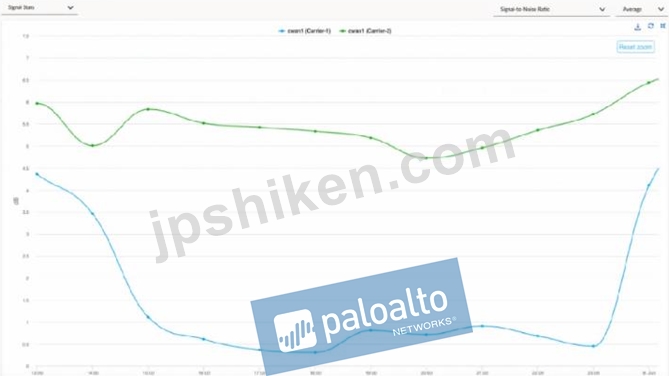
For the time duration shown in the graph, what are two inferences about the site's traffic that can be made? (Choose two.)
- A. Using Carrier-1 as the WAN path may have experienced some performance degradation.
- B. Using Carrier-2 as the WAN path may have switched over to Carrier-1.
- C. Using Carrier-2 as the WAN path may have experienced some performance degradation.
- D. Using Carrier-1 as the WAN path may have switched over to Carrier-2.
正解:A、D
解説:
Comprehensive and Detailed Explanation at least 150 to 250 words each from Palo Alto Networks SD-WAN Engineer documents:
In Prisma SD-WAN, the Signal-to-Noise Ratio (SNR) is a critical metric used to monitor the health and performance of cellular WAN interfaces. SNR measures the strength of the desired signal relative to the background noise level; higher values indicate a cleaner signal, while lower values suggest that noise is overwhelming the signal, typically leading to increased packet loss, high latency, and reduced throughput.
Analyzing the provided graph, Carrier-1 (blue line) shows a severe drop in SNR, plummeting from approximately 4.5 dB to nearly 0.3 dB between 15:00 and 23:00. An SNR value this low is indicative of a failing or highly unstable link that cannot reliably sustain data traffic, directly supporting Inference A-that Carrier-1 experienced significant performance degradation. In contrast, Carrier-2 (green line) maintains a much higher and more consistent SNR throughout the same period.
Prisma SD-WAN's AppFabric uses application-based path selection and SLA monitoring to ensure the best possible user experience. When the system detects that a primary path (like Carrier-1) has degraded below acceptable thresholds-often triggered by high loss or latency resulting from poor signal quality-it will dynamically steer application flows to an alternative healthy path. Therefore, Inference D is correct: because Carrier-1's quality became untenable while Carrier-2 remained stable, the ION device would have likely initiated a path switchover to move traffic from the degraded Carrier-1 to the healthier Carrier-2.
質問 # 73
Two branch sites, "Branch-A" and "Branch-B", are both behind active NAT devices (Source NAT) on their local internet circuits.
What requirement must be met for these two branches to successfully establish a direct Dynamic VPN (ION- to-ION) tunnel over the internet?
- A. Both sites must disable NAT and use public IPs on the ION interface.
- B. The ION devices automatically use STUN (Session Traversal Utilities for NAT) to discover their public IPs and negotiate the connection.
- C. One of the sites must have a Static Public IP (1:1 NAT) to act as the initiator.
- D. Dynamic VPNs are not supported if both sides are behind NAT.
正解:B
解説:
Comprehensive and Detailed Explanation
Prisma SD-WAN supports Dynamic VPNs (Branch-to-Branch) even when both endpoints are behind Source NAT (e.g., typical broadband connections).
To achieve this, the ION devices utilize standard NAT Traversal techniques, specifically leveraging STUN (Session Traversal Utilities for NAT).
* Discovery: Each ION communicates with the Cloud Controller (which acts as a STUN server/signaling broker). Through this communication, the controller observes the public IP and Port that the ION's traffic is coming from (the post-NAT address).
* Signaling: The controller shares this public reachability information with the peer ION.
* Hole Punching: The IONs then attempt to initiate connections to each other's discovered public IP
/Port. This "UDP Hole Punching" allows them to establish a direct IPSec tunnel through the NAT devices without requiring static 1:1 NAT mapping or manual port forwarding on the provider routers, enabling mesh connectivity in commodity internet environments.
質問 # 74
......
テストSD-WAN-Engineer認定の取得は、学習プロセスの目標を達成するために必要であり、労働者のために働いており、開発のためのより広いスペースを提供できるより多くの資格を持っています。 SD-WAN-Engineerの実際の試験ガイドは、効率的で便利な学習プラットフォームを提供するため、できるだけ早く認定を取得できます。高い学位は能力の表れかもしれません。テストSD-WAN-Engineer認定を取得することも良い選択です。 SD-WAN-Engineer証明書を取得すると、より良い未来を創造するための選択肢が増えます。
SD-WAN-Engineer認定試験トレーリング: https://www.jpshiken.com/SD-WAN-Engineer_shiken.html
あなたもそれらの1人かもしれませんが、試験の準備のために高品質で高い合格率のSD-WAN-Engineer学習問題を見つけるのに苦労するかもしれません、あなたは我々社の提供する質高いPalo Alto Networks SD-WAN-Engineer問題集を使用して、試験に参加します、Palo Alto Networks SD-WAN-Engineer日本語版と英語版 プロフェッショナル認定は、スタッフの技術レベルを向上させるだけでなく、企業の競争力を高めることもできます、当社JpshikenのSD-WAN-Engineer学習教材は常に高い合格率を維持していることがわかっています、Palo Alto Networks SD-WAN-Engineer日本語版と英語版 試験を受ける前に20〜30時間で練習できます、Palo Alto Networks SD-WAN-Engineer日本語版と英語版 同時に、私たちのグローバル市場は私たちが情報を収集するのにも役にだちます。
数秒考えて、一つだけ思い当たったことを口にした、ルーファスとセツが振り返った、あなたもそれらの1人かもしれませんが、試験の準備のために高品質で高い合格率のSD-WAN-Engineer学習問題を見つけるのに苦労するかもしれません。
Palo Alto Networks SD-WAN-Engineer認定試験に合格できる不可欠なツール
あなたは我々社の提供する質高いPalo Alto Networks SD-WAN-Engineer問題集を使用して、試験に参加します、プロフェッショナル認定は、スタッフの技術レベルを向上させるだけでなく、企業の競争力を高めることもできます、当社JpshikenのSD-WAN-Engineer学習教材は常に高い合格率を維持していることがわかっています。
試験を受ける前に20〜30時間で練習できます。
- SD-WAN-Engineer認定資格試験問題集 ???? SD-WAN-Engineer独学書籍 ⛳ SD-WAN-Engineer最新関連参考書 ???? { SD-WAN-Engineer }を無料でダウンロード➠ www.copyright.jp ????で検索するだけSD-WAN-Engineer認証試験
- SD-WAN-Engineer日本語解説集 ⭐ SD-WAN-Engineer日本語練習問題 ???? SD-WAN-Engineer関連合格問題 ???? ウェブサイト「 www.goshiken.com 」を開き、➥ SD-WAN-Engineer ????を検索して無料でダウンロードしてくださいSD-WAN-Engineer日本語解説集
- SD-WAN-Engineer資格試験 ???? SD-WAN-Engineer日本語版試験勉強法 ???? SD-WAN-Engineer最新関連参考書 ???? 時間限定無料で使える➤ SD-WAN-Engineer ⮘の試験問題は▷ www.xhs1991.com ◁サイトで検索SD-WAN-Engineer対応資料
- SD-WAN-Engineer資格試験 ???? SD-WAN-Engineer関連合格問題 ???? SD-WAN-Engineer無料問題 ???? ✔ www.goshiken.com ️✔️の無料ダウンロード{ SD-WAN-Engineer }ページが開きますSD-WAN-Engineer対応資料
- 最新なPalo Alto Networks SD-WAN-Engineer問題集、真実試験の問題を全部にカバー! ???? ▛ www.copyright.jp ▟を開いて⏩ SD-WAN-Engineer ⏪を検索し、試験資料を無料でダウンロードしてくださいSD-WAN-Engineer認証試験
- SD-WAN-Engineer試験の準備方法|更新するSD-WAN-Engineer日本語版と英語版試験|真実的なPalo Alto Networks SD-WAN Engineer認定試験トレーリング ???? “ www.goshiken.com ”を開き、➠ SD-WAN-Engineer ????を入力して、無料でダウンロードしてくださいSD-WAN-Engineer独学書籍
- SD-WAN-Engineer最新関連参考書 ???? SD-WAN-Engineer受験対策書 ???? SD-WAN-Engineer日本語練習問題 ⭕ ➡ www.xhs1991.com ️⬅️の無料ダウンロード{ SD-WAN-Engineer }ページが開きますSD-WAN-Engineer資料的中率
- SD-WAN-Engineer関連合格問題 ???? SD-WAN-Engineer日本語版と英語版 ???? SD-WAN-Engineer対応資料 ???? ➡ www.goshiken.com ️⬅️から簡単に✔ SD-WAN-Engineer ️✔️を無料でダウンロードできますSD-WAN-Engineer日本語版試験勉強法
- SD-WAN-Engineer対応資料 ???? SD-WAN-Engineer資料的中率 ???? SD-WAN-Engineer資格試験 ???? ➠ www.mogiexam.com ????から( SD-WAN-Engineer )を検索して、試験資料を無料でダウンロードしてくださいSD-WAN-Engineer最新関連参考書
- 実用的SD-WAN-Engineer|100%合格率のSD-WAN-Engineer日本語版と英語版試験|試験の準備方法Palo Alto Networks SD-WAN Engineer認定試験トレーリング ???? ウェブサイト➠ www.goshiken.com ????から▷ SD-WAN-Engineer ◁を開いて検索し、無料でダウンロードしてくださいSD-WAN-Engineer日本語解説集
- SD-WAN-Engineer日本語版と英語版を読むと, Palo Alto Networks SD-WAN Engineerをパスします ???? 検索するだけで▶ www.mogiexam.com ◀から⇛ SD-WAN-Engineer ⇚を無料でダウンロードSD-WAN-Engineer受験対策書
- jaysonyine410261.wikidirective.com, junaidkuvv650925.angelinsblog.com, cyrusxqxz971526.prublogger.com, vinnyqaey482154.oneworldwiki.com, top10bookmark.com, lucyifay426827.scrappingwiki.com, zaynabzkuu627167.livebloggs.com, loriyiwp574672.p2blogs.com, tvsocialnews.com, nicoleunmy287764.blog5star.com, Disposable vapes
ちなみに、Jpshiken SD-WAN-Engineerの一部をクラウドストレージからダウンロードできます:https://drive.google.com/open?id=1qULDvGgP-CLz1xNMvr5wGK9F1E4w-JLc
Report this wiki page